6 The Earned Income Tax Credit
Question for this chapter. If a household works but does not earn much, is it worth checking the Earned Income Tax Credit (EITC)? Does the answer change when there is interest or dividends from U.S. stocks or from a bank deposit in the home country? What changes with the number of children and the filing status?
Short answer. The Earned Income Tax Credit is a tax credit for households with income from work. The maximum credit depends on the number of children. The filing status sets the income where the credit starts to shrink and the income where it ends. If investment income is more than $11,950, the credit is not available. Without children, an age rule also applies. The values and judgments in this chapter are checking assumptions for tax year 2025. The real amount depends on how the household's income is made up and on its documents.
6.0 Names and rules
The Earned Income Tax Credit is part of U.S. federal income tax. It is meant for working households with low or moderate income. This chapter uses the IRS publication on the EITC and the individual income tax return instructions for tax year 2025 as its sources. It shows the order in which the credit sorts out who qualifies. It does not decide anything for the household. Instead, it lists what a household can check and which documents to look at.
Term box — Earned Income Tax Credit (EITC). A tax credit for households with income from work. It is subtracted directly from the tax owed. It is also called the EIC. Some other countries have a similar in-work credit; this book does not cover them.
Term box — Earned income. Income from work, such as wages and salary. Net earnings from self-employment can also count. The exact scope of earned income is an item to check in the return instructions.
Term box — Investment income. Income from money or assets, such as interest and dividends. The EITC has a limit on this income.
Term box — Qualifying child. A person who counts as a "child" for this credit. There are separate rules, such as an age rule. These rules can differ from the child rules for other tax credits.
Term box — Phase-out range. Once income passes a certain amount, the credit starts to shrink. When income rises further, the credit ends. In this book, the stretch from where the credit starts to shrink to where it ends is called the phase-out range.
Keep three things separate when reading about this credit:
- The tax this credit reduces.
- The settlement difference on the return once it is fully calculated. This is the amount still owed or the amount to be returned.
- The refund that actually reaches the bank account.
These three are not the same. Withholding, other deductions and other credits all work at the same time. How any part of the credit that is larger than the tax owed is handled is an item to check in the return instructions.
The values in this chapter are 2025 tax-year values. Whether each transcribed value has been checked against the official document is shown by the status label in the table at the end of this chapter.
6.1 How the size of the credit changes with the number of children
The size of the credit depends on the number of qualifying children. There are four cases: no children, one child, two children, and three or more children. Each case has two values. One is the maximum credit. The other is the amount of earned income at which the maximum credit is reached.
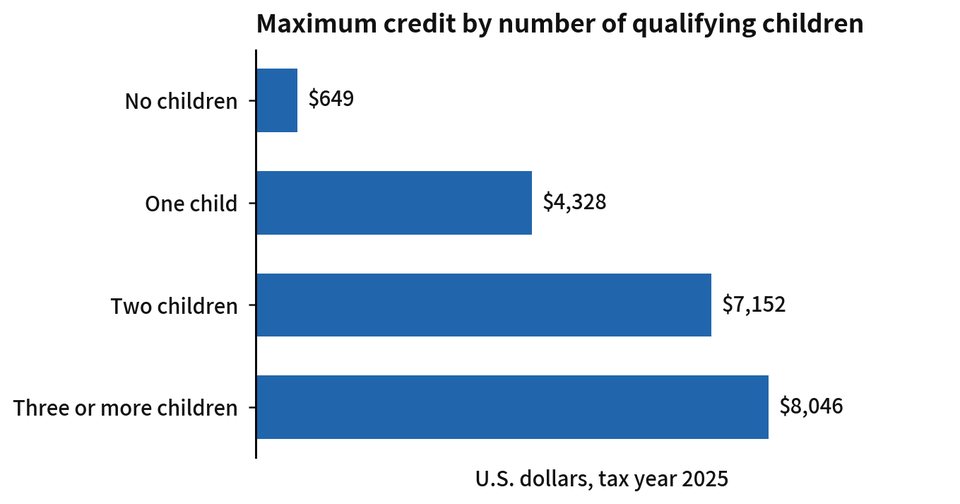
Figure 6-1. The maximum credit is larger when there are more qualifying children. These are ceilings, not amounts a household receives.
| Qualifying children | Maximum credit | Earned income at which the maximum is reached |
|---|---|---|
| None | $649 | $8,490 |
| One | $4,328 | $12,730 |
| Two | $7,152 | $17,880 |
| Three or more | $8,046 | $17,880 |
The maximum credit grows with the number of children. It is larger with one child than with none, larger with two than with one, and larger with three or more than with two. The earned income at which the maximum is reached is also higher with one child than with none, and higher with two than with one.
The general shape of the credit works like this. As earned income rises, the credit grows. It reaches the maximum at the earned income amount in the table. After that, once income passes the phase-out start, the credit shrinks (see section 6.2). The exact credit is set by IRS tables and worksheets. This chapter does not calculate it.
Example. A household with one parent. A single parent of Mexican background lives in New Jersey with one child in elementary school. The parent works in a restaurant and is paid wages. This household uses the "One" row of the table. If earned income is below $12,730, the credit is still on the side below the maximum. If earned income reaches that amount, the household checks the side near the maximum credit of $4,328. First, though, the household needs to confirm that the child meets the qualifying child rules (section 6.4) and that investment income is within the limit (section 6.3).
Assumption. This section assumes the household has only earned income, the child is a qualifying child, and investment income is within the limit. Whether the household falls in the phase-out range is covered separately in section 6.2.
How to read it. Use the table to pick the row that applies to the household. Decide the number of children first. Then read that row's maximum credit only as a ceiling. The maximum credit is not the amount the household receives. The real credit can be smaller, depending on where income falls and on the other requirements.
6.2 Filing status and the phase-out range
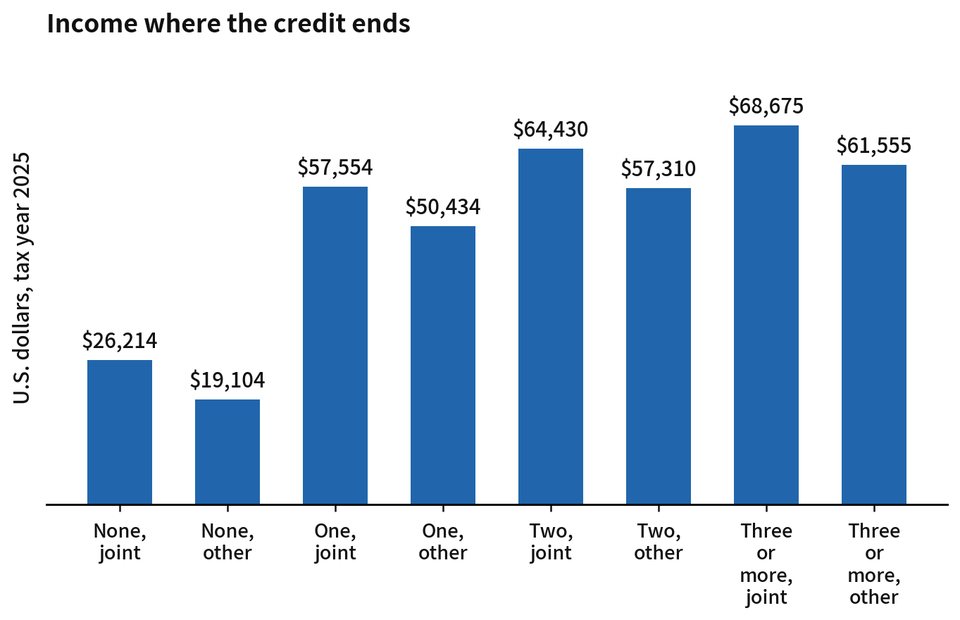
Figure 6-2. For the same number of children, the credit ends at a higher income for married filing jointly than for other filing statuses.
Term box — Filing status. The category chosen when filing a tax return. This chapter uses two groups: married filing jointly, where a couple files one return together, and all other filing statuses.
The phase-out range depends on the filing status and the number of children. The phase-out start has two values: one for no children and one for households with children. With children, the same phase-out start applies no matter how many children there are. The income where the credit ends is different for each number of children.
| Qualifying children | Phase-out start (joint) | Credit ends at (joint) | Phase-out start (other) | Credit ends at (other) |
|---|---|---|---|---|
| None | $17,730 | $26,214 | $10,620 | $19,104 |
| One | $30,470 | $57,554 | $23,350 | $50,434 |
| Two | $30,470 | $64,430 | $23,350 | $57,310 |
| Three or more | $30,470 | $68,675 | $23,350 | $61,555 |
The table shows several patterns:
- For the same number of children, the phase-out start is higher for married filing jointly than for other statuses.
- For the same number of children, the income where the credit ends is also higher for married filing jointly than for other statuses.
- The phase-out start with children is higher than without children.
- Within each filing status, the income where the credit ends is higher when there are more children.
Example. A two-earner couple with two children. A couple of Chinese background in California files jointly and has two qualifying children. If their combined wages are below $30,470, they are not yet in the phase-out range. If their income is above that and below $64,430, they are in the phase-out range, and the credit is smaller than the maximum. If their income reaches $64,430, the credit ends. With the same income, the result can differ if this household uses a filing status other than married filing jointly, because the "other" columns then apply.
Assumption. Which income is used to place a household in the phase-out range follows the calculation order in the return instructions. This section only shows the step of comparing the "income" columns in the table with the household's matching income. How a couple can choose a filing status is not covered in this chapter.
How to read it. First choose the filing status columns. Then choose the row for the number of children. Note where the household's income falls:
- Below the phase-out start: "before phase-out."
- Between the phase-out start and the income where the credit ends: "in phase-out."
- At or above the income where the credit ends: "no credit."
Check the exact amount on the worksheet.
6.3 The investment income limit
A household can have earned income that fits the rules and still lose the credit if it has too much investment income. For tax year 2025 the investment income limit is $11,950. If investment income is more than this amount, the credit is not available, whatever the number of children or the filing status.
Households with ties to another country need to look at this part closely. Besides dividends and interest from a U.S. brokerage account, many have interest from a bank deposit in the home country or dividends from home-country stocks. How this kind of foreign income enters the investment income figure for this credit is an item to check in the return instructions and the IRS publication. How to report home-country income on a U.S. return is not covered in this chapter.
Example. A couple with a deposit in the home country. A couple of Indian background in Texas has no children and files jointly. Both have wages. They have a deposit in the home country inherited from a parent, and it pays interest. They also get some dividends from a U.S. account. The household first gathers all interest and dividends, from both the U.S. and the home country. From that, it works out the amount this credit treats as investment income. If the total is more than $11,950, the credit is no longer worth checking. If it is not, the household goes on to the "None" row in section 6.2 and the age rule in section 6.4.
Assumption. This section assumes the household has sorted out what counts as investment income by following the instructions. Whether items such as capital gains or rental income count as investment income is an item to check in the instructions.
How to read it. The investment income limit is a cutoff. Above it, the credit is gone. It does not shrink step by step the way the phase-out range does. So it makes sense to check this limit before working on the credit amount. Interest and dividend amounts appear on the year-end documents that financial institutions send. For how to read those documents, see Chapter 8 (withholding and reading your documents).
6.4 Qualifying children and the age rule for filers without children
There are two age rules. One decides whether a child counts as a qualifying child. The other applies to the filer when checking the credit without children.
| Item | Rule |
|---|---|
| Age of a qualifying child (at year-end) | Under 19 |
| Age of a child who is a student | Under 24 |
| Minimum age of the filer, without children | 25 or older |
| Upper age limit of the filer, without children | Under 65 |
A qualifying child must be under 19 at the end of the year. A child who is a student can be a qualifying child up to a higher age, under 24. When a child counts as a "student" is an item to check in the IRS publication.
To check the credit without children, the filer must be 25 or older and under 65. How the ages of a married couple filing jointly are treated is an item to check in the instructions.
Example. A household with a child in college. A couple of Canadian background in Seattle has a child in college. If the child is 19 or older but under 24 and meets the student requirement, the couple can check whether the child counts as a qualifying child. Whether the same rule applies when the child attends a university abroad, and how time living together is counted, are items to check in the instructions. If this child is not a qualifying child, the couple uses the "None" row in sections 6.1 and 6.2. In that case, they also check their own ages against the age rule.
Assumption. This section covers only the age rules. A qualifying child may also have to meet other requirements beyond age, such as relationship and time living together. Those are not covered in this chapter. Rules for children and dependents continue in Chapter 5 (credits for children and dependents). This chapter does not assume that the child rules for the credits in Chapter 5 are the same as the rules for this credit.
How to read it. A household with children first checks whether each child is a qualifying child. That result decides the row in the section 6.1 table. A household without children, or with children who are not qualifying children, checks the filer's own age. Doing these steps in a different order leads to the wrong row.
6.5 Self-employment income and the forms involved
Term box — Net self-employment earnings. Business income minus business expenses. For this credit, it can count as earned income. Self-employed filers therefore need to calculate it accurately.
Many households with ties to another country have self-employment income, for example from a dry cleaner, a nail salon, a restaurant or freelance work. The IRS publication has two dollar thresholds related to self-employment income.
| Item | Threshold | What the publication says |
|---|---|---|
| Self-employment tax form threshold | $400 or more | Schedule SE and related forms must be completed accurately |
| Optional method threshold | Less than $7,240 | Point at which to consider whether the optional method on Schedule SE applies |
If net self-employment earnings are $400 or more, Schedule SE and related forms must be completed accurately. If net self-employment earnings are less than $7,240, whether to use the optional method on Schedule SE is an item to consider. How the optional method affects the result of this credit is not covered in this chapter. It is a point to confirm in the instructions and with a tax professional.
There is one more threshold. The IRS publication has a part that says who must use a worksheet. Among people who file certain forms, those with earned income of $68,675 or less may be required to use that worksheet. Which forms bring a filer into this group is an item to check in that publication.
Example. A single parent who runs a nail salon. A single parent of British background runs a small nail salon in Atlanta and lives with two children in high school. The parent has no wages, only self-employment income. The household first organizes business income and expenses to find net self-employment earnings. If that amount is $400 or more, the parent confirms whether Schedule SE is needed. Then the household uses the "Two" row in the section 6.1 table and the "other" columns in the section 6.2 table. If expenses are left out or overstated, net earnings change, and the household's position on the credit can change with them.
Assumption. This section assumes net self-employment earnings are supported by books and receipts. Which expenses count as business expenses is not covered in this chapter.
How to read it. For a self-employed household, the starting point for checking this credit is whether net earnings were calculated accurately. Read the two thresholds in the table as signals for which forms and methods to review. They are not credit amounts.
6.6 When the credit is not available
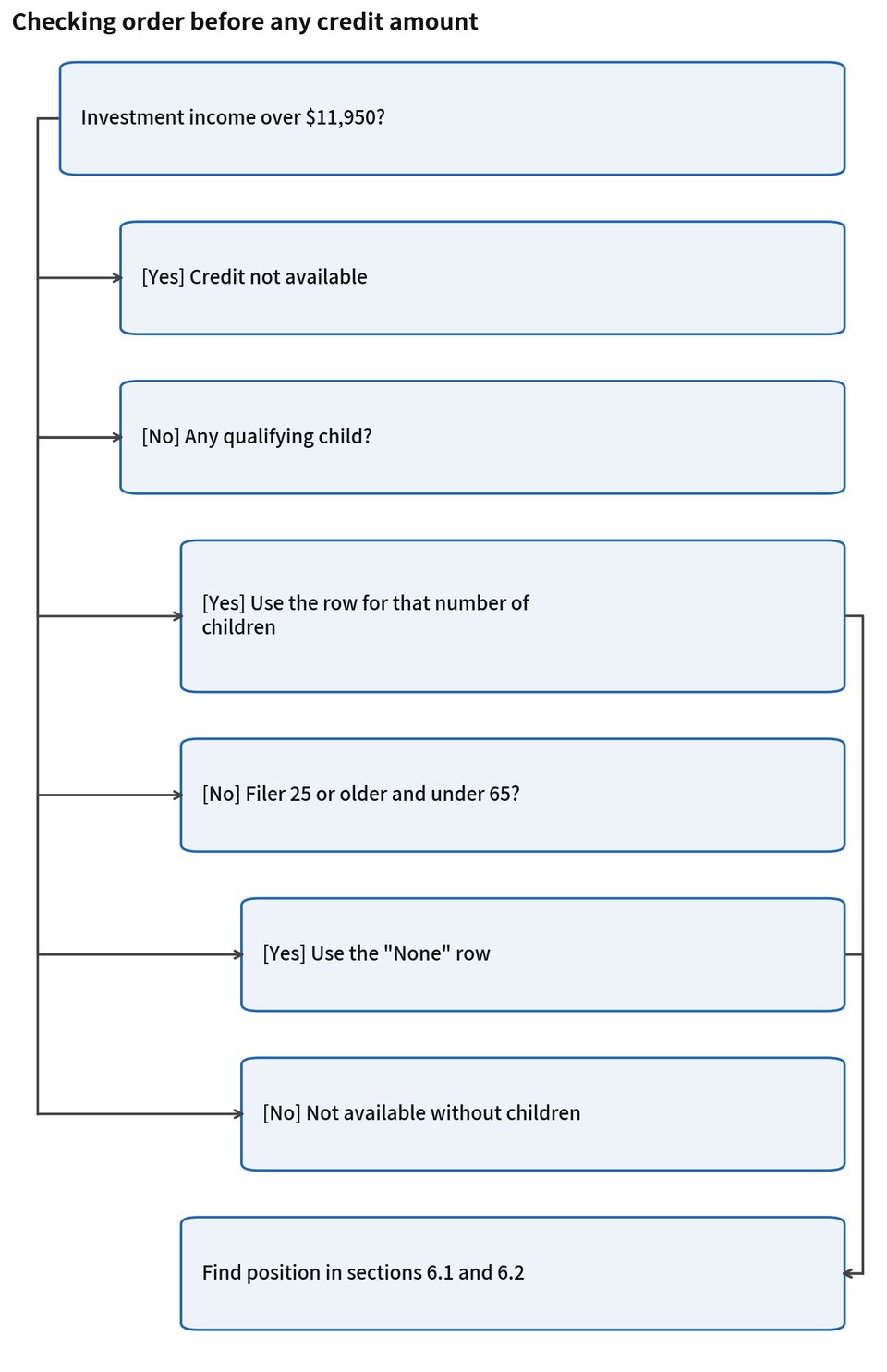
Figure 6-3. Check the investment income limit first, then qualifying children, then the filer's own age, before choosing a row in the tables.
Who does not qualify
The exclusions and limits that can be confirmed from this chapter's sources are:
- Investment income over the limit. If investment income is more than $11,950, the credit is not available.
- Income at the point where the credit ends. If income reaches the "credit ends at" amount in the section 6.2 table for the household's filing status and number of children, no credit remains.
- Filing without children and not meeting the age rule. If the filer is under 25 or is 65 or older, the credit is not available without children.
- A child above the age limit. A child who is 19 or older at the end of the year is not a qualifying child. A student can still be a qualifying child up to under 24. If a child is not a qualifying child, the household cannot use a row that includes that child.
- The credit was denied or reduced in the past. If it was denied or reduced because of carelessness or a similar reason, there is a 2-year period during which the credit cannot be claimed. To claim it again after that, the filer must file the recertification form set by the IRS. If it was denied because of fraud, the period is longer, 10 years. To claim it again after that period, the filer must file the same recertification form.
There is also a special rule for separated spouses. It uses a period of 6 months living apart from the spouse. If this condition is met, which filing status can be used to check the credit, and what other requirements apply, are items to check in the return instructions.
Other exclusions are not covered in this chapter. These include the Social Security number requirement, the residency requirement, how the credit is treated when the filer chooses the foreign earned income exclusion, and the case where the filer is someone else's qualifying child. These items need to be checked separately in the IRS publication.
Assumption. The list above contains only the reasons that can be confirmed from this chapter's sources. A real eligibility decision also depends on requirements outside this list.
How to read it. This list works well as a checking order to follow before looking at any credit amount. Check the investment income limit, the age and child rules, and any past denial first. Then move on to the tables in sections 6.1 and 6.2.
FAQ
Question. Is the credit largest when income is close to zero? Answer. No. The credit grows as earned income rises and reaches the maximum at the earned income amount in the section 6.1 table. With very little earned income, the credit can also be small.
Question. Does interest from a deposit in the home country count as investment income? Answer. How foreign interest and dividends enter the investment income figure for this credit is an item to check in the return instructions. Going over the limit means the credit is not available. A household with accounts in the home country should check this point first.
Question. If the credit was denied in the past, can it never be claimed again? Answer. The period during which it cannot be claimed depends on the reason for the denial. After that period, a new claim must include the recertification form set by the IRS.
What this comparison shows
Among working households, the credit can look very different along three axes. The first is the number of children. It changes the maximum credit and the income where the credit ends. The second is the filing status. It changes where the phase-out range starts and ends. The third is investment income. Above the limit, it blocks the credit regardless of the first two. For households with ties to another country, the special point is that interest and dividends from the home country can enter the third axis. Chapter 2 (how much is missed) gives the broad picture of how often this credit may be missed.
Limits of this chapter
- This chapter does not calculate the credit amount. The real amount is set by IRS tables and worksheets.
- It does not cover the details of which income is used for the phase-out range, or exactly what counts as earned income and investment income.
- It does not cover qualifying child requirements other than age (such as relationship and time living together), the Social Security number requirement or the residency requirement.
- For the separated spouse rule, it gives only the time condition, not the rule's specific effect.
- It does not cover how to report home-country income on a U.S. return, or how this credit relates to the foreign earned income exclusion.
- It does not cover state earned income credit programs.
- The values in this chapter are 2025 tax-year values. By evidence level, the threshold amounts and age rules in the tables are values taken from the sources. The position of each example household is conditional on the stated assumptions.
What is confirmed / What cannot be decided yet / Information you need
What is confirmed
- The maximum credit is $649 with no children, $4,328 with one, $7,152 with two and $8,046 with three or more. It is larger when there are more children.
- For the same number of children, the phase-out start and the income where the credit ends are higher for married filing jointly than for other statuses.
- If investment income is more than $11,950, the credit is not available.
- To check the credit without children, the filer must be 25 or older and under 65.
- A qualifying child must be under 19 at year-end, or under 24 if a student.
- After a past denial, there is a 2-year or 10-year period depending on the reason, and a new claim requires the recertification form.
What cannot be decided yet
- The household's actual credit, and how it carries through to the settlement difference on the return and to the refund that reaches the bank account.
- Whether investment income, including interest and dividends from the home country, is within the limit.
- Whether a child in college or a child living in the home country meets the qualifying child requirements beyond age.
- Which filing status a separated couple can use to check the credit.
- For a self-employed household, whether to use the optional method on Schedule SE.
Information you need
- Filing status, and each child's age at year-end and student status.
- Earned income shown on wage statements, and, for self-employment, records of business income and expenses.
- Year-end interest and dividend statements from U.S. and home-country financial institutions.
- If checking without children, the filer's age (both spouses' ages if filing jointly).
- Whether the credit was ever denied or reduced, and the reason.
- If separated, the length of time living apart from the spouse.
Key values and sources in this chapter
| Value | What it is | Status | Source |
|---|---|---|---|
| $11,950 | Investment income limit | Extracted value, review pending | IRS Rev. Proc. 2024-40 (rp-24-40) |
| $649 | Maximum credit (no children) | Extracted value, review pending | IRS Rev. Proc. 2024-40 (rp-24-40) |
| $8,490 | Earned income amount (no children) | Extracted value, review pending | IRS Rev. Proc. 2024-40 (rp-24-40) |
| $4,328 | Maximum credit (one child) | Extracted value, review pending | IRS Rev. Proc. 2024-40 (rp-24-40) |
| $12,730 | Earned income amount (one child) | Extracted value, review pending | IRS Rev. Proc. 2024-40 (rp-24-40) |
| $7,152 | Maximum credit (two children) | Extracted value, review pending | IRS Rev. Proc. 2024-40 (rp-24-40) |
| $17,880 | Earned income amount (two children) | Extracted value, review pending | IRS Rev. Proc. 2024-40 (rp-24-40) |
| $8,046 | Maximum credit (three or more children) | Extracted value, review pending | IRS Rev. Proc. 2024-40 (rp-24-40) |
| … | 23 other values | "Notes and appendix" tab on the book's site |