How to Read This Book
Question for this chapter. Where should you start in this book? How should you read the ranges, assumptions and status labels attached to the numbers? How do you find the path through the book that fits your household?
Short answer. Pick a reading path based on two facts: where your household lives, and which countries hold your income and assets. Every chapter follows the same order. You can skim the "Question for this chapter" and "Short answer" first, then read the assumptions and limits in the chapters you need. A number in this book is not a single correct answer. Read it with its range, its assumptions and its evidence level. The book's values are 2025 tax-year values. The status label on each value shows whether the transcribed value has been checked against the official document.
0.0 Names and rules
Term box — Reading path. A short list of chapters chosen for one type of household. It suggests an order but does not require it.
Term box — Settlement difference. The gap between the tax a return shows you owe and the tax you already paid through withholding or estimated payments. It can mean more to pay or an amount to be refunded. It is not the same as the money that reaches your bank account.
Term box — Evidence level. How firmly a value or judgment is supported by its source: a confirmed value, a value that depends on assumptions, or a weakly supported value.
Term box — Status label. A label that shows how far a transcribed value has been checked: Official rule confirmed, Extracted value, review pending, Conditional example, or Application undecided.
0.1 What this book does and does not do
Explanation. This book is a guide to checking deductions, credits and filings in two countries. It is written for households living in the U.S. that have ties to other countries. Income, assets or taxes in another country are treated as part of what the household needs to track alongside the U.S. return.
The book shows how to check, with evidence and stated assumptions, for deductions and credits you may have missed. It does not say "if you have this item, you get this much back."
Throughout the book, three things are kept separate:
- The taxable income or tax that a deduction or credit reduces
- The settlement difference after the return is complete (more to pay, or an amount to be refunded)
- The refund that actually reaches your bank account
These three are different. If a chapter leaves you unsure which of the three it is discussing, read Chapter 1, "Deductions, credits and refunds are different," first.
Assumption. The book assumes you can see your own returns or withholding documents. If you do not have them, start with the "Information you need" list in each chapter.
How to read it. Treat the book as a list of questions to check, not a to-do list. Answering each question requires your own documents.
0.2 How each chapter is built
Explanation. Every main chapter, except the front matter, follows the same order. Once you know the order, you can go straight to the parts you need.
| Order | Name | What it holds |
|---|---|---|
| First | Question for this chapter | The question readers actually ask |
| Second | Short answer | The core answer and the assumptions it rests on |
| Third | Names and rules | Plain names, term boxes, and the source of each rule |
| Fourth | Numbered sections | Explanation, example households, assumptions, how to read it |
| Fifth | FAQ | Short questions and answers |
| Sixth | Limits of this chapter | What is not covered, and where the answer depends on the case |
| Seventh | What is confirmed / What cannot be decided yet / Information you need | The chapter's conclusions in three groups |
Chapters that check one deduction or credit at a time also have a subsection called "Who does not qualify." Ruling out the cases where a benefit does not apply matters as much as finding the benefit.
Example. A two-earner household with U.S. wages wants to know whether to take the standard deduction or itemize. The household opens Chapter 4, "Standard and itemized deductions," and reads the "Question for this chapter" and "Short answer" first. Next, the household reads the "Information you need" group to see which documents to gather. Once the documents are in hand, the household compares its situation with the assumptions in each numbered section, one at a time.
How to read it. If you are short on time, read only the "Short answer" and "What cannot be decided yet" in each chapter. "What cannot be decided yet" collects the points that need more of your own information before anyone can judge them.
0.3 Reading paths by reader
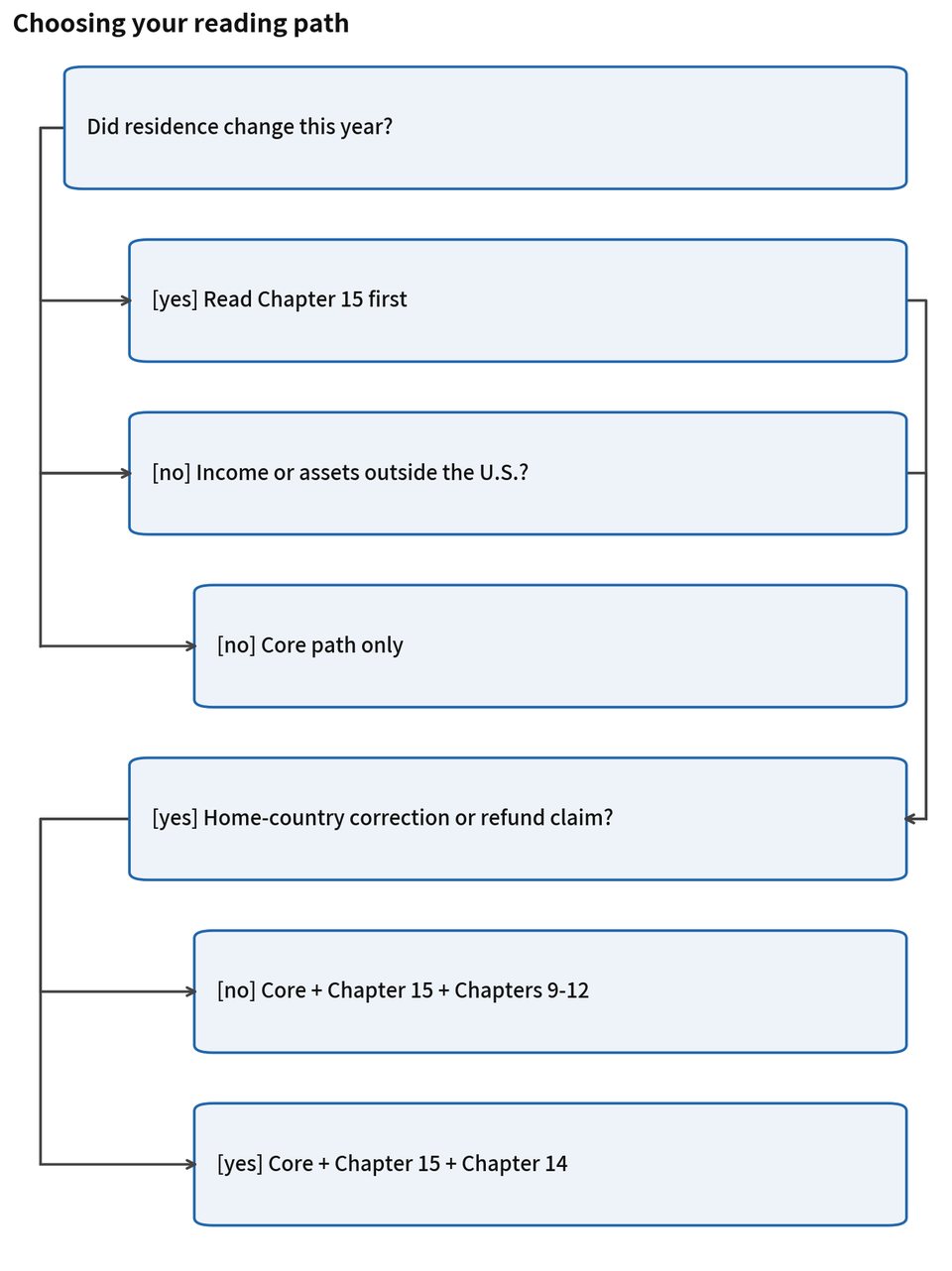
Figure 1. Start with where you lived and where your income and assets are. A change of residence during the year points to Chapter 15 first.
Explanation. Choose a path based on where you live and which countries hold your income and assets. Then follow the chapters in the table. The home-country chapters (Chapters 9-12, six countries) cover Mexico, China, India, Canada, the U.K. and Colombia. Chapter 14 (where to start a home-country correction or refund claim, six countries) shows where to begin a correction or refund claim.
| Reader | Path | What to read |
|---|---|---|
| Household living in the U.S. | Core path | Chapters 1–8, Chapter 13, Chapters 20–21 |
| U.S. household with income or assets in your home country (Mexico, China, India, Canada, the U.K. or Colombia) | Core path plus | The core path, Chapter 15, and the home-country chapters (Chapters 9-12, six countries) |
| U.S. household considering a home-country correction or refund claim | Core path plus | The core path, Chapter 15, and Chapter 14 (where to start a home-country correction or refund claim, six countries) |
Example. A Mexican household works in the U.S. and has inherited assets in Mexico. It follows the second row. It reads the U.S. core path first, then Chapter 15, "Residency status, treaties and the foreign tax credit," then the home-country chapters (Chapters 9-12, six countries). Which country taxes what depends on residency status. Confirming residency status early, using Chapter 15, makes the other chapters easier to follow.
Example. A household earns wages in the U.S. and has income in Canada. It follows the second row. It reads the core path to set up the U.S. side, then Chapter 15, then the home-country chapters (Chapters 9-12, six countries).
Assumption. The table sorts readers only by where they live and which countries hold their income. A household that changed residence during the year may not fit any single row. That household should follow a cross-border path and read Chapter 15 first.
How to read it. The paths do not force an order. However, some later chapters do not re-explain concepts from earlier chapters. On a first read, following the order in the table is the clearest way through.
0.4 How to read the numbers
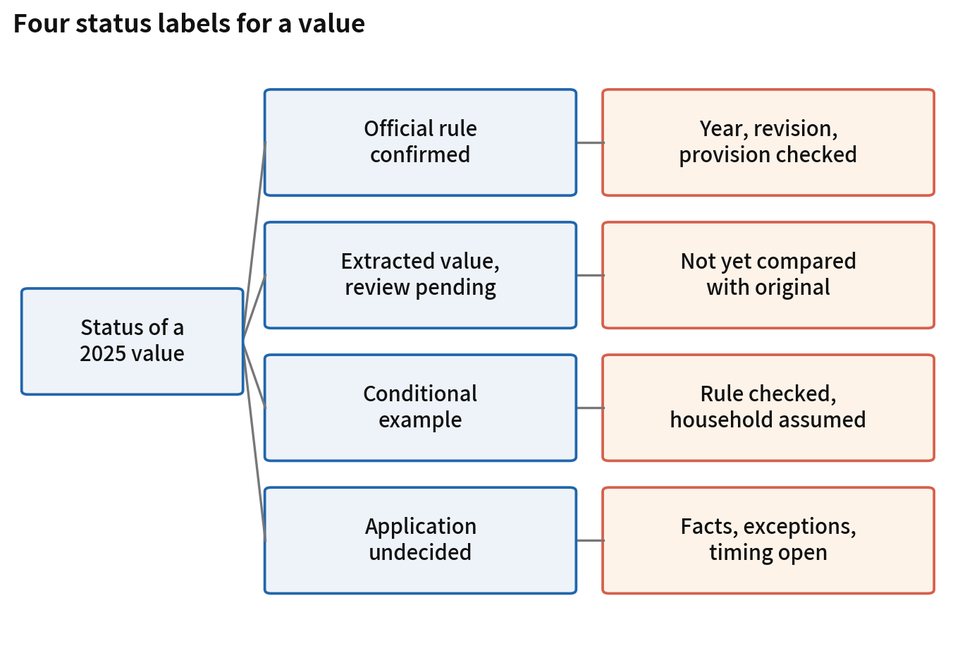
Figure 2. Every value is a 2025 tax-year value. Its status label shows how far the transcription and its application have been checked.
Explanation. All amounts, percentages, limits and age thresholds in this book are 2025 tax-year values. The official 2025 forms and instructions have been published. The values in this book were transcribed from those official documents. The status of each transcribed value appears once, in the status column of the table where the value is listed, not next to every mention. Read each status as follows.
| Status | What it means for the reader |
|---|---|
| Official rule confirmed | The tax year, the document's revision date and the governing provision have been checked |
| Extracted value, review pending | Taken from an official source, but the transcription and interpretation have not yet been compared with the original |
| Conditional example | The rule has been checked, but the figure is calculated for an assumed household |
| Application undecided | Personal facts, exceptions or effective dates still need to be checked |
"Review pending" does not mean the law is unsettled. It means the comparison of the transcribed value with the original document is not finished.
Check four things whenever you read a number:
- Tax year. The same rule can carry different values from year to year. This book's values are for 2025.
- Range. An example household's result is better read as a range than as a single value. The two ends of a range come from different assumptions.
- Assumptions. Each numbered section states its own "Assumption." If your situation differs from that assumption, the number does not carry over to your household as written.
- Size relationships. When two values are compared, rely only on the relationship stated in the book. If two different rules happen to produce the same value, the book does not describe them as the same standard.
Example. An example household in one chapter shows that its itemized deductions add up to more than the standard deduction. That result depends on the deduction items and amounts assumed for that household. If your items are different, the relationship may reverse. In that case, do not copy the numbers. Go back to that chapter's "Information you need" and compare it with your own documents.
How to read it. Chapter 20, "Reading ranges, assumptions and evidence levels," covers this in more detail. You can read Chapter 20 before any chapter with many numbers.
0.5 Evidence levels
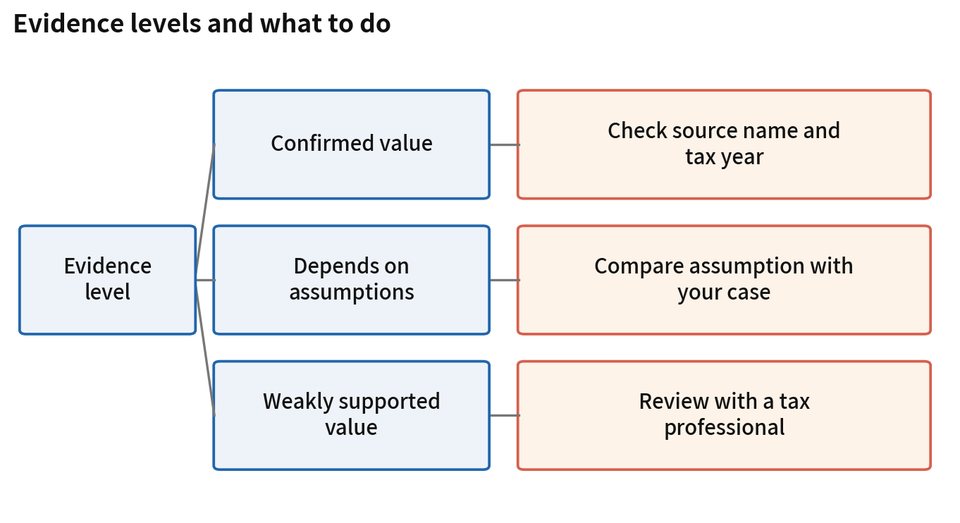
Figure 3. Evidence level shows how firm the source is. A judgment built on a weakly supported value is weak too.
Explanation. For each value and judgment, the book shows how firmly it is supported.
| Evidence level | Meaning | What the reader does |
|---|---|---|
| Confirmed value | Found in a form, instruction or statute, together with its tax year | Check the source name and tax year together |
| Value that depends on assumptions | Changes with the household's situation (income, family makeup, residency status and so on) | Compare the chapter's "Assumption" with your own situation |
| Weakly supported value | The source is limited, or interpretations differ | Mark it as an item to review with a tax professional |
When the book states a rule, it names the form, instruction or statute and the tax year. The Internal Revenue Service (IRS) and the home country's tax agency are mentioned only as sources. The book has no partnership with any agency. When the book quotes news reports, statistics or company announcements, it says who said it and when. It also keeps a company's own claims separate from what was reported about the company.
Assumption. An evidence level shows how clear the source is. It does not mean the transcribed value has been compared with the original. That is what the status label shows.
How to read it. If a judgment rests on a weakly supported value, treat the judgment as weak too. Add such items to the list you review with a professional before filing.
0.6 Term boxes and plain names
Explanation. The "Names and rules" section of each chapter has boxes that explain terms appearing for the first time in that chapter. A box looks like this:
Term box — Tax credit. An amount subtracted directly from the tax you have calculated. It works at a different step from a deduction, which reduces taxable income.
The book uses the plain name first. Form and statute names appear only in parentheses or in table headings. Plain names you will see often are standard deduction, itemized deduction, tax credit, deduction, refund, amended return, and the home-country request for correction. The U.S. amended return and the home-country request for correction can look alike. They are different procedures in different countries, and the book treats them separately.
How to read it. If a term is unfamiliar, go back to the box in the chapter where it first appeared. A term that first appears in the middle of a chapter is explained once, at that point.
0.7 How the book relates to the website
Explanation. A website accompanies this book (aitaxinvesting.com). The book's values and the site's values come from the same set of rules. For the same tax year and the same assumptions, the two should match. If they seem to differ, compare the tax year and the assumptions first. Like the book, the site shows items to check. It does not prepare a return.
How to read it. Use the book to understand the reasons and assumptions. Use the site to change your household's conditions and see what shifts.
FAQ
Question. Do I have to read the book from start to finish? Answer. No. Pick your path from the table in section 0.3 and read only the chapters on that path.
Question. Can I copy the book's numbers straight onto my return? Answer. The book's numbers are 2025 tax-year values. Each one carries a status label showing whether its transcription has been checked against the official document. The numbers also follow the assumptions of an example household. Use them as a starting point for checking your own documents against the official forms and instructions.
Question. I am not sure which path my household is on. Answer. If you have any income or assets outside the U.S., follow a cross-border path and start with Chapter 15.
Limits of this chapter
- This chapter covers only how to read the book. It does not cover the requirements or amounts of any specific deduction or credit.
- The reading path table sorts readers only by where they live and which countries hold their income. It may not fit households that changed residence during the year, or households where family members have different residency status.
- The book's values were transcribed from the official 2025 forms and instructions. Each value's status label shows how far its transcription has been checked. Values can change from year to year, so check them against that year's official documents before filing.
What is confirmed / What cannot be decided yet / Information you need
What is confirmed
- Each chapter follows the same order: question, short answer, names and rules, numbered sections, FAQ, limits, and the three-group summary.
- There are three reading paths: households living in the U.S., U.S. households with income or assets in their home country, using the home-country chapters, and U.S. households considering a home-country correction or refund claim, using Chapter 14.
- Values are 2025 tax-year values. They are marked with one of three evidence levels and one of four status labels.
- The book's values and the website's values come from the same set of rules.
What cannot be decided yet
- Which path your household is on cannot be settled until you confirm your residency status and the countries that hold your income and assets.
- Whether a deduction or credit applies to your household can be judged only after you compare that chapter's assumptions with your own documents.
Information you need
- A record of where you lived during the year and whether your residency status changed
- A list of income and assets in the U.S. and in each other country, with withholding documents
- Copies of returns you have already filed, if any
- A list of the questions you want answered, to match against each chapter's "Question for this chapter"