5 Children and Dependents
Question for this chapter. How much can having children lower a household's tax? Is there a credit for supporting a parent or another relative? And what does it mean when people say part of the child credit "comes back as a refund"?
Short answer. The Child Tax Credit takes up to $2,200 directly off tax for each child who meets the requirements. Dependents who do not qualify for the Child Tax Credit may qualify for the Credit for Other Dependents, which is $500 per person. If the tax owed is smaller than the credit, up to $1,700 per child can be figured as a refundable part. That amount depends on earned income and on the calculation method. When income goes above set thresholds, the credits shrink. No single number answers "how much is one child worth." The answer depends on the household's income, its tax, and who supports whom.
5.0 Names and rules
This is the second chapter of Part 2, which covers general U.S. rules. The standard deduction and itemized deductions in Chapter 4 reduce the income that tax is figured on (taxable income). The credits in this chapter come off the tax after it has been figured. Chapter 1 explains the difference between the two in detail.
Term box — Child Tax Credit. An amount subtracted directly from tax when the filer has a child who meets the age, relationship and other requirements. The limit is $2,200 per child.
Term box — Credit for Other Dependents. An amount subtracted from tax for each dependent who does not qualify for the Child Tax Credit. The amount is $500 per person.
Term box — Additional Child Tax Credit. The refundable part of the Child Tax Credit. If the tax owed is too small to use the full Child Tax Credit, part of the unused amount can be treated as if it were tax already paid. The limit is $1,700 per child.
Term box — Phase-out. A rule that gradually reduces a credit once income passes a set threshold. For married filing jointly, the reduction starts above $400,000. For single and other filing statuses, it starts above $200,000.
Term box — Dependent. A family member the filer supports who meets the tax law's relationship, income and support requirements. Both credits in this chapter apply only to a dependent.
This chapter covers three credits. The table shows what each one is for.
| Name | For whom | Amount or limit per person | When the tax is too small |
|---|---|---|---|
| Child Tax Credit | Qualifying child who meets the age requirement | Up to $2,200 | Part may be figured as refundable |
| Additional Child Tax Credit | The unused share for those children | Up to $1,700 | This is the refundable part |
| Credit for Other Dependents | Dependents who do not qualify for the Child Tax Credit | $500 | This chapter does not cover any refundable part |
Assumption. This chapter covers federal income tax only. State taxes are not covered. Filing eligibility and taxpayer identification number requirements are in section 5.6.
How to read it. The amounts in the table are maximums or per-person amounts. The amount that actually reduces a household's tax can be smaller. It depends on the household's tax, earned income and income level. The table lists the items a household can check for itself.
The values in this chapter are 2025 tax-year values. The status labels in the table at the end of the chapter show whether each transcribed value has been checked against the official document.
5.1 Child Tax Credit: who qualifies and up to how much
Explanation. The first test for the Child Tax Credit is age. The child must be under 17 at the end of the tax year. A child who turned 17 by the end of the year does not qualify for the Child Tax Credit (IRS Child Tax Credit guidance). The remaining check is how the child's age appears in the documents.
For each child who meets the age requirement, up to $2,200 comes directly off tax. A household with two children applies the same limit separately to each child.
Three things must be kept apart here:
- This credit reduces the tax itself.
- The settlement difference on the return is the extra amount owed or the amount to be paid back. It is set by comparing the tax with what was already paid through withholding.
- The money that actually reaches the bank account depends on that settlement and on other items on the return.
A $2,200 child credit does not mean $2,200 comes back to the household.
Example — Household A. A married couple files jointly. They have two children who meet the age requirement. Assume household income is below $400,000.
| Item | Value for this household |
|---|---|
| Credit limit per child | $2,200 |
| Children who qualify | Two |
| Phase-out threshold (married filing jointly) | $400,000 |
Assumption. Both children meet the dependent requirements for this household. No other household is claiming the same children. Household income is below the phase-out threshold, so no phase-out applies.
How to read it. This household can check up to $2,200 for each of the two children. Whether the full limit comes off tax depends on how much tax the household owes. If the tax is smaller than the credit limit, the unused share moves to the refundable calculation in section 5.2.
5.2 What "part of it is refundable" means
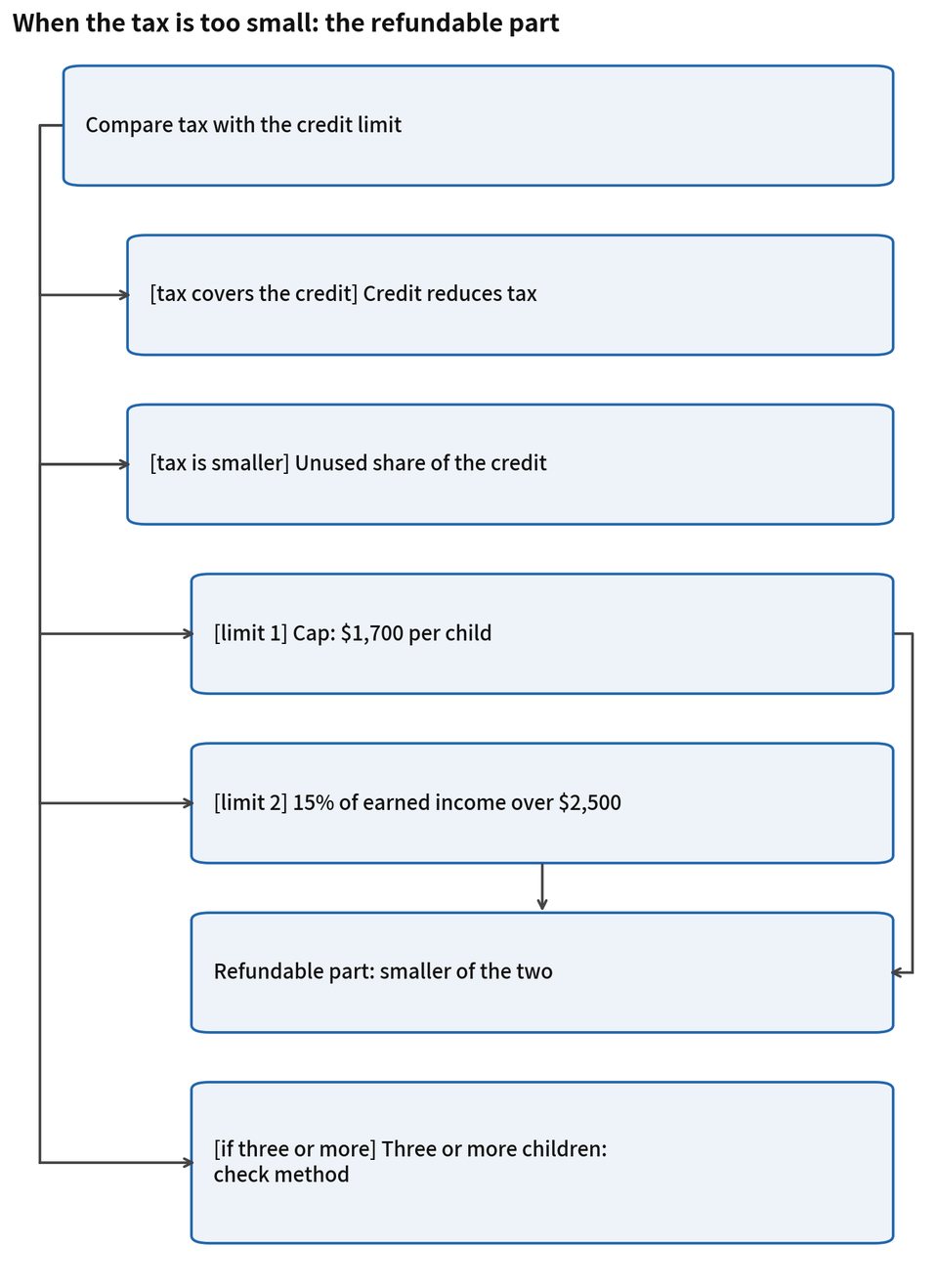
Figure 5-1. If the tax is smaller than the credit limit, the unused share moves to the refundable calculation. The refundable amount is limited to the smaller of the per-child cap and 15% of earned income above $2,500.
Explanation. A tax credit usually reduces tax only down to zero. If the tax is smaller than the credit, the rest of the credit goes unused. The Child Tax Credit allows part of that unused share to be figured as refundable. That part is the Additional Child Tax Credit.
Term box — Earned income. Income from work, such as wages or self-employment income. It sets the size of the Additional Child Tax Credit.
Two limits apply to the refundable part at the same time.
| Type of limit | Rule |
|---|---|
| Cap per child | $1,700 |
| Earned-income calculation | 15% of earned income above $2,500 |
| Three or more children | A separate method is used if a certain amount is $5,100 or more |
The refundable cap of $1,700 per child is lower than the $2,200 Child Tax Credit limit. A household with almost no tax therefore cannot use the full Child Tax Credit limit as a refundable amount.
The earned-income calculation counts only income above $2,500. If earned income does not pass that starting point, this method produces no refundable amount. Households with three or more children have another method. What the "certain amount" is, and how the two methods are compared, is something to check in the instructions for the schedule used to figure the Child Tax Credit.
Example — Household B. A parent files as single or under another non-joint status. The parent has one child who meets the age requirement and earned income slightly above $2,500. Assume the tax owed, before considering withholding, is close to zero.
Assumption. Household income is well below $200,000, so no phase-out applies. The child is this parent's dependent.
How to read it. With almost no tax owed, only a small part of the Child Tax Credit is used to reduce tax. The refundable part matters more for this household. The refundable amount is limited to the smaller of two values: the $1,700 per-child cap, or 15% of earned income above the starting point. When earned income is only slightly above the starting point, the second value is small and the refundable amount may not reach the cap. As earned income rises, the refundable amount can grow up to the cap.
On the return, the refundable part is treated as if it were tax already paid. It pushes the settlement toward money coming back. The money that actually reaches the bank account is still set together with other credits, withholding and other tax items. The Earned Income Tax Credit (EITC), which lower-income working households can check alongside this credit, is covered in Chapter 6.
5.3 Dependents who are not qualifying children: the Credit for Other Dependents
Explanation. Some dependents can be checked for the Credit for Other Dependents if they meet the dependent requirements. This includes a child past the Child Tax Credit age requirement, a parent who lives with the filer, or another relative. The credit is $500 per person. That is less than the $2,200 Child Tax Credit limit and less than the $1,700 refundable cap.
This credit has several requirements to check.
| Item to check | Rule |
|---|---|
| Yearly gross income of a relative who is not a child | Less than $5,200 |
| Student requirement for an adult child who is a student | Met for at least 5 months of the year |
| Each person's share when several people provide support together | More than 10% |
Term box — Multiple support agreement. An arrangement in which several people share a person's living costs and agree that one of them will claim that person as a dependent. A typical case is several siblings sharing a parent's support.
To claim a dependent under a multiple support agreement, the person claiming must pay more than 10% of the support. Section 5.6 covers the documents the agreement requires. This is an item to check in the relevant instructions.
Example — Household C. A married couple files jointly and lives with an elderly mother. Assume the mother's yearly gross income is below $5,200. The couple also has an adult child in college. That child is past the Child Tax Credit age requirement and was a student for at least 5 months of the year.
Assumption. The couple pays most of the mother's living costs. The adult child meets the other dependent requirements. Household income is below $400,000.
How to read it. Neither the mother nor the adult child qualifies for the Child Tax Credit. Each can instead be checked for the $500 Credit for Other Dependents. The documents to check are the mother's yearly income records and school records showing the child's enrollment period. If the couple shares the mother's support with siblings, the first item to check is whether the couple's share is more than 10%.
5.4 Credits that shrink at higher incomes
Explanation. The Child Tax Credit and the Credit for Other Dependents shrink when income passes a threshold. The threshold depends on the filing status.
| Filing status | Phase-out threshold | Reduction rate |
|---|---|---|
| Married filing jointly | $400,000 | 5% |
| Single and other statuses | $200,000 | 5% |
The $400,000 threshold for married filing jointly is higher than the $200,000 threshold for single and other statuses. The credit is reduced by 5% of the income above the threshold. Some calculation details are items to check in the return instructions. These include which income figure is compared with the threshold, and whether income is rounded up in set steps.
Example — Household D. Same makeup as Household A: married filing jointly, with two children who meet the age requirement. Assume this household's income is above $400,000.
Assumption. All other requirements are the same as for Household A.
How to read it. This household checks the credits for two children, but at the amount reduced by the income above the threshold. Income slightly above the threshold reduces the credit a little. Income far above the threshold reduces it more. At the same income, a household filing as single or under another non-joint status starts losing the credit at a lower income.
5.5 When the credits are reduced or not available
Who does not qualify
Under the rules in this chapter, the credits shrink or disappear in these cases.
- A child past the age requirement. A child who is not under 17 at the end of the tax year does not qualify for the Child Tax Credit. If the child meets the dependent requirements, the Credit for Other Dependents can be checked.
- A relative whose gross income is at or above the limit. A relative who is not a child must have yearly gross income of less than $5,200. A relative at or above that amount does not meet this requirement.
- An adult child with a short student period. If the student requirement is not met for at least 5 months of the year, the dependent decision that relies on student status may change.
- A low share under a multiple support agreement. If the person's share of support is not more than 10%, that person cannot claim the credit through the agreement.
- Income above the phase-out threshold. The credit is reduced at a 5% rate. If income is high enough, no credit may remain.
- Earned income at or below the starting point. The earned-income calculation produces no refundable amount. Households with three or more children also need to check the separate method.
Section 5.6 covers several other rules: time lived with the child, taxpayer identification numbers, citizenship and residency requirements, and tie-breaker rules when someone else claims the same child.
5.6 Checking with documents and evidence
Explanation. For dependent credits, documents come before claims. Start with the order of the tests. To be anyone's dependent, a person must first pass three tests: the dependent taxpayer test, the joint return test, and the citizen or resident test. Next, the person must be either a qualifying child or a qualifying relative. Gather evidence for each item in that order.
Evidence at a glance
| Item to check | What to confirm | Example documents (matched to confirmed rules) |
|---|---|---|
| Relationship | The person has one of the listed relationships: child, stepchild, foster child, sibling or a descendant of one, and others. An adopted child is always treated as the filer's own child. This includes a child placed with the filer for legal adoption. | Birth certificate, adoption or foster placement records |
| Residence | The person lived with the filer for more than half the year. Temporary absences, such as for illness or school, count as time lived together. | School or medical records, documents showing the address |
| Age | For the Child Tax Credit, the child must be under 17 at the end of the year. A child can be a qualifying child by being young, by being a full-time student who meets certain conditions, or by being permanently and totally disabled. The child must also be younger than the filer (or the filer's spouse). | Birth certificate, enrollment records, disability records |
| Self-support | The child did not provide more than half of the child's own support. | The child's income and spending records |
| Taxpayer identification number | See the separate explanation below | Social Security card or other records showing the number |
Checking taxpayer identification numbers
- In the dependents section, enter the person's taxpayer identification number: an SSN, ITIN or ATIN. A missing or wrong number can cause the tax benefit to be disallowed. Which number is required differs by credit, as the next three points show.
- For the Child Tax Credit, including the refundable ACTC, the child must have a valid SSN for work in the United States. The SSN must be issued by the return due date, including extensions. The filer must also have a valid SSN. On a joint return, at least one spouse must have a valid SSN, and the other spouse needs either an SSN or an ITIN.
- The Credit for Other Dependents has a different number rule. The dependent must be a U.S. citizen, U.S. national or resident alien. The dependent must have an SSN, ITIN or ATIN issued by the due date.
- A qualifying child may be born and die in the same year without receiving an SSN. In that case, attach a birth certificate, death certificate or hospital records. These must show that the child was born alive.
- The same person cannot be checked for both the Child Tax Credit and the Credit for Other Dependents.
Evidence for a qualifying relative
- Gross income: the person's yearly gross income must be less than $5,200.
- Support: the filer must provide more than half of the person's support. Support includes food, housing, clothing, education, medical care, transportation and similar costs. Housing is valued at fair rental value. Keep receipts and transfer records, grouped by item.
- The person must not be the qualifying child of the filer or of any other taxpayer.
Multiple support documents
No single person may provide more than half the support, but several people together may. In that case, an agreement lets one of them claim the person. The person claiming must provide more than 10% of the support. Each of the others must give a signed statement agreeing not to claim the person. Keep each person's support records together with the signed statements.
Divorced parents and claims by more than one person
- The custodial parent is the parent the child spent more nights with during the year. Records of where the child spent the night are the basis for this.
- For the noncustodial parent to claim the child, the custodial parent must release the claim on Form 8332 or a written statement with the same content.
- A child may count as a qualifying child for more than one person. Then only one person can claim the child, based on tie-breaker rules such as who the parent is and how long the child lived with each person. This also applies to line 19 (the child and dependent credit line) and line 28 (the refundable credit line).
If a claim was denied in the past
Attach Form 8862 in one situation: the Child Tax Credit or a related credit for a year after 2015 was denied or reduced for a reason other than a math or clerical error. If an improper claim was due to reckless or intentional disregard of the rules, the filer cannot take the credit for 2 years. If it was due to fraud, the bar is 10 years.
What the comparison shows
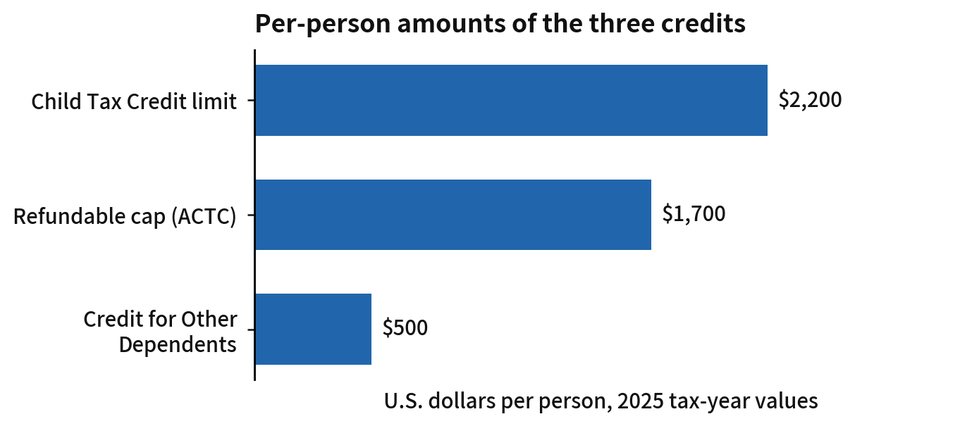
Figure 5-2. The $2,200 Child Tax Credit limit is the largest, then the $1,700 refundable cap, then the $500 Credit for Other Dependents. All are per-person amounts, not amounts a household will receive.
Explanation. The three credits rank in this order. The $500 Credit for Other Dependents is the smallest. The $1,700 refundable cap is next. The $2,200 Child Tax Credit limit is the largest. All three are per-person amounts.
So the same family changes credits in the year a child passes the age requirement, and the amount gets smaller. For a household with little tax, the refundable calculation matters more than the credit limit. For a higher-income household, the phase-out threshold matters more. Each household has a different first item to check.
FAQ
Question. Is $2,200 per child refunded as is? Answer. No. That amount is the limit on a credit that reduces tax. When the tax is too small, the refundable part is capped at $1,700 per child, and it can be smaller depending on earned income.
Question. Is there a credit for a child in college? Answer. A child past the Child Tax Credit age requirement does not qualify for the Child Tax Credit. If the child meets the dependent requirements, the $500 Credit for Other Dependents can be checked.
Question. Do these credits reduce income, like the standard deduction? Answer. No. The credits in this chapter come directly off tax. Deductions that reduce income are covered in Chapter 4. Chapter 1 explains the difference between the two.
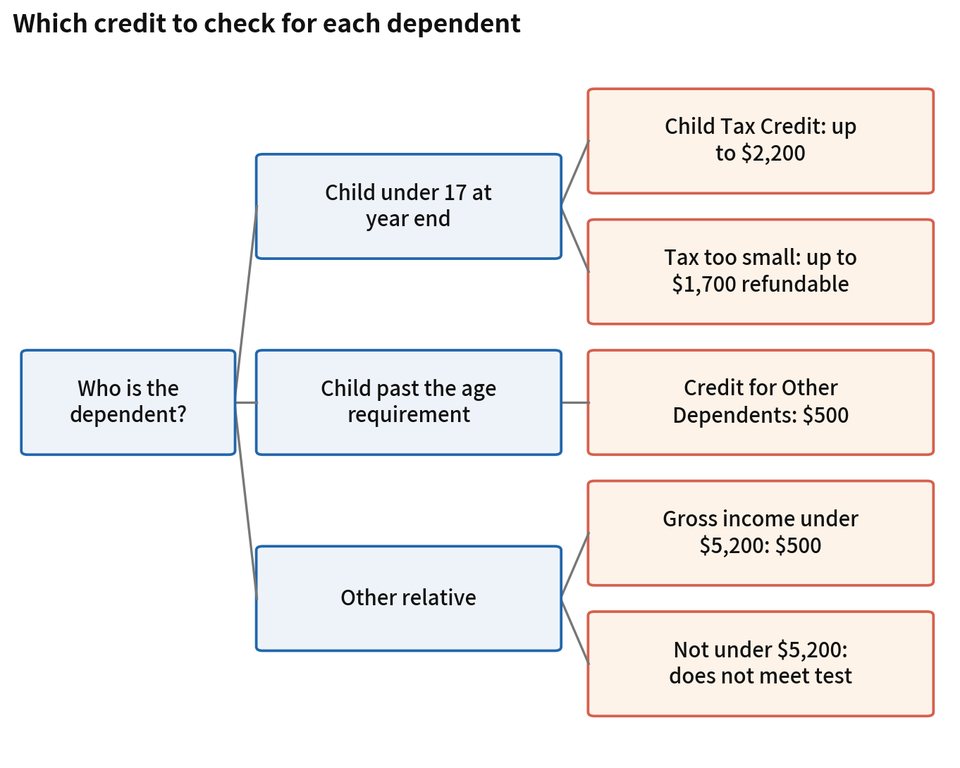
Figure 5-3. A child under 17 at the end of the year is checked for the Child Tax Credit. A child past the age requirement, or a relative with gross income under $5,200, is checked for the $500 Credit for Other Dependents.
Limits of this chapter
- The actual credit, the refundable amount and the settlement depend on the household's tax, earned income, withholding and other credits. This chapter does not calculate those results.
- This chapter does not cover which income figure is used for the phase-out or how rounding works.
- This chapter does not cover what the "certain amount" is in the separate method for three or more children, or the order of that calculation.
- The wording of the age requirement can look different from one source to another. Check it against the text of the instructions.
- This chapter does not cover whether the Credit for Other Dependents has a refundable part, and does not cover state taxes. Residency and taxpayer identification number requirements, and rules for divorced or separated parents, are in section 5.6.
- The values in this chapter are 2025 tax-year values. The status labels in the table below show whether each transcribed value has been checked against the official document.
What is confirmed / What cannot be decided yet / Information you need
What is confirmed
- The Child Tax Credit is up to $2,200 per child who meets the age requirement, and it comes directly off tax.
- The refundable part is capped at $1,700 per child. A second limit comes from the calculation of 15% of earned income above $2,500.
- Dependents who do not qualify for the Child Tax Credit can get $500 per person.
- The phase-out starts at a 5% rate above $400,000 for married filing jointly and above $200,000 for single and other statuses.
What cannot be decided yet
- Without the household's actual tax, the credit limit cannot be split into the share that reduces tax and the share that moves to the refundable calculation.
- For a household with three or more children, it cannot be decided which of the two calculation methods applies.
- When several people share support, who claims the dependent cannot be decided until the family's agreement and each person's share are checked.
Information you need
- Filing status (married filing jointly, single or another status) and the income figure used for the phase-out
- Each child's age at the end of the tax year
- Earned income records (pay statements, self-employment income records)
- Yearly gross income records for dependents who are not children
- School records showing the enrollment period of an adult child who is a student
- If support is shared, each person's record of support paid
Key values and sources in this chapter
| Value | What it is | Status | Source |
|---|---|---|---|
| $2,200 | Child Tax Credit per child | Extracted value, review pending | IRS Instructions for Schedule 8812 (i1040s8) |
| $500 | Credit for Other Dependents | Extracted value, review pending | IRS Schedule 8812 (f1040s8) |
| $1,700 | Refundable credit limit per child | Extracted value, review pending | IRS Instructions for Schedule 8812 (i1040s8) |
| $400,000 | Phase-out threshold (married filing jointly) | Extracted value, review pending | IRS Schedule 8812 (f1040s8) |
| $200,000 | Phase-out threshold (single) | Extracted value, review pending | IRS Schedule 8812 (f1040s8) |
| 17 | Age threshold for the Child Tax Credit | Extracted value, review pending | IRS Pub. 501 (p501) |
| $2,500 | Earned-income starting point for the refundable credit | Extracted value, review pending | IRS Schedule 8812 (f1040s8) |
| 15% | Rate for the refundable credit calculation | Extracted value, review pending | IRS Schedule 8812 (f1040s8) |
| … | 12 further values | — | "Notes and appendix" tab on the book's site |